Living by the water has always been a crucial lifeline for humans throughout history. Living near water has lots of advantages, such as having a ready source of drinking water, or for cleaning, bathing, and farming. Living by the water also allows people to trade, generate power, explore, travel and communicate, or even for aesthetics and status.
However, all across the world in a variety of cultures, people have transitioned from living near the water to living on the water. Some people live their lives in modern floating houses with electricity and street parking, others on floating islands made entirely of plants, and there are those prefer to dwell on creaky wooden houseboats. From groups of sea-adapted nomads, expansive fishing villages, to city-sized stilted neighbourhoods, here are 9 of the most amazing and surprising ways that people live on the water.
Canal Houseboats, The Netherlands
Houseboats are one of the most iconic images of The Netherlands. Many cities in The Netherlands flourished using systems of canals to transport people and goods within urban areas and inbetween cities. Today, they’re increasingly known as places to moor a houseboat.
Living in houseboats started in the 60s and 70s using old cargo barges in Amsterdam, called woonschepen. They were often synonymous with a life of poverty, or a frugal artists’ lifestyle, and while often in deteriorating condition, many survive today. As the benefits of living in houseboats became more recognised for its economical and innovative use of urban space, houseboats became more popular.
Today, most modern houseboats are specially-constructed vessels called arken anchored to the canal bed with a concrete or steel foundation. They have electricity, water, sewerage systems, letterboxes, sometimes even rooms below water level. In an effort to prevent overcrowding of canals, the Dutch government capped the number of houseboat permits at 2400, making houseboats an increasingly sought-after and expensive mode of living.
Read more about Dutch house boats here!

Penang Clan Jetties, Malaysia
On the shoreline of the city of Penang, Malaysia are the Clan Jetties, long wooden boardwalks with residential houses, built far out onto the water. The Clan Jetties were first built in the 19th century by Chinese immigrants working in the fast-growing port city. With the city exporting tin and spice, a huge market opened up for labourers, traders, and dock workers. As a cheap housing option, Chinese families built the clan jetties to form Chinese communities, usually naming each jetty after one family.
Altogether 10 Clan Jetties were built, although only 6 survive today. Each jetty is still inhabited, and retain traditional customs on each. A small temple is situated at the entrance to each jetty, as well as another at the end. While the Jetties have electricity, telephone lines, water and air conditioning, the wooden boards and posts that support them need constant maintenance.
The Clan Jetties are private residences, however one (Chew Jetty) is open to the public, allowing visitors to walk up and down, admiring the small gardens, shops, hairdressers, and boats along the way.
Learn about all the Penang Clan Jetties here!
Bajau Peoples of South East Asia
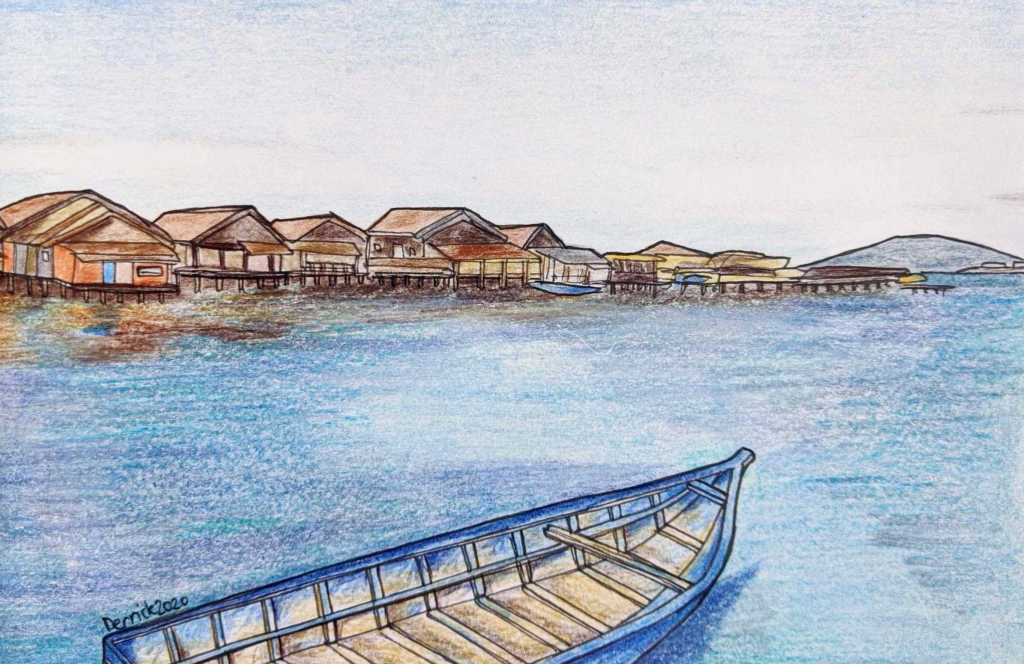
Living in the waters off The Phillipines, Malaysia and Indonesia are seaborne communities of people collectively known as Bajau. Numbering over a million people, the Bajau peoples live semi-nomadic lifestyles, on traditional wooden dugout houseboats called lepa lepa, or in wooden huts supported by wooden stilts built just offshore.
With a diet based primarily on fish and seafood, most Bajau men are fishermen, and they have developed extraordinary diving skills. With wooden-framed goggles and hand-crafted spear guns, Bajau fisherman sometimes hold their breath for around three minutes to dive (most people can only last a minute or so). A fisherman might spend around 5 hours underwater collecting food, and reach depths of 70 metres (229 feet).
Today, the homes of the ‘sea gypsies’, as the Bajau are sometimes known, are increasingly modern, with electricity, phones and running water. However, their lives are still very much tied to the sea, and are even genetically adapted to it, with genes giving them a larger spleen to provide more oxygen when diving.
Inle Lake, Myanmar
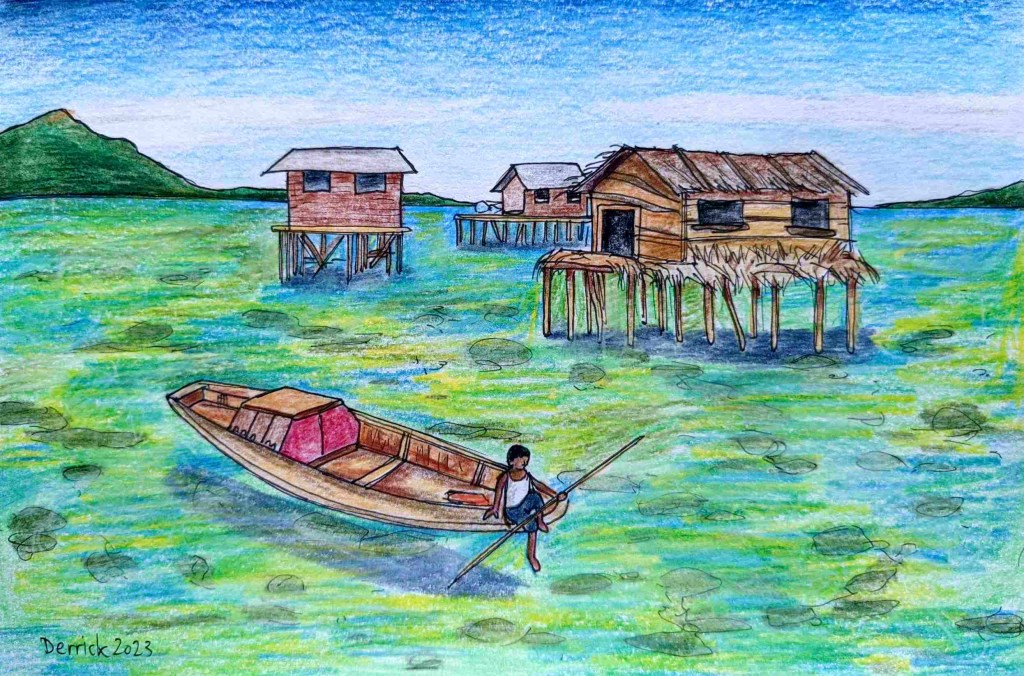
The second largest lake in Myanmar is Inle Lake in Shan state, a freshwater lake that covers 116km2 (44.9 square miles). An important wildlife ecosystem for many endemic species of floating plants, snails, and freshwater fish, it is also one of the most unique communities in Myanmar.
Inle Lake is home to the Intha people (as well as other ethnic groups), who live in cities and settlements around the shoreline, as well as on floating communities in the lake itself. Most homes on the lake are built of wood and bamboo, planted in the lake bed with long stilts. Temples and even buoyant garden beds also float on the lake.
Many residents are self-sufficient fishermen, farmers, and silversmiths, and move around on small boats powered by oars or outboard motors. Inle Lake fishermen are perhaps best known for their unique rowing style, in which the rower wraps one leg around the oar, holding the oar steady with one hand whilst keeping the other hand free to cast their net.

Ha Long Bay, Vietnam
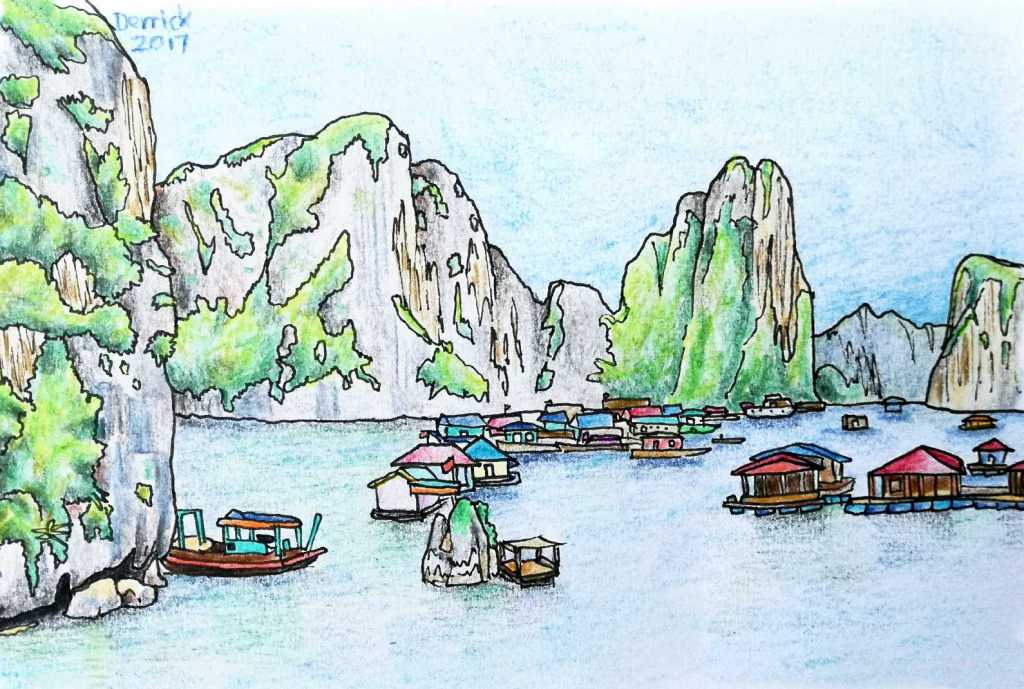
One of the most recognisable sights in Vietnam, and by far its most popular tourist site is Ha Long Bay. Located off the coast of northern Vietnam, Ha Long Bay is a collection of thousands of limestone karsts and islands rising out of a majestic azure sea. Ha Long Bay has been the site of human habitation for thousands of years.
While the vast majority of people who ply the waters between the karsts are tourists on excursions to admire the bay, a small population still reside on the water. Some small fishing villages – Cong Tau, Cua Van, Ba Hang, and Vong Vieng – are still operational on Ha Long Bay. While people don’t live on them full time, they are used for fishing and for tourism.
Cai Beo is one of the largest villages on the Cat Ba archipelago, with about 300 houses floating on the water, linked by boardwalks and pontoons. Fishing is the primary occupation, and other supplies like vegetables and fish sauce are purchased from the mainland. Archaeological finds from the island indicate humans have lived here at least 7000 years.
Aberdeen Floating Village, Hong Kong
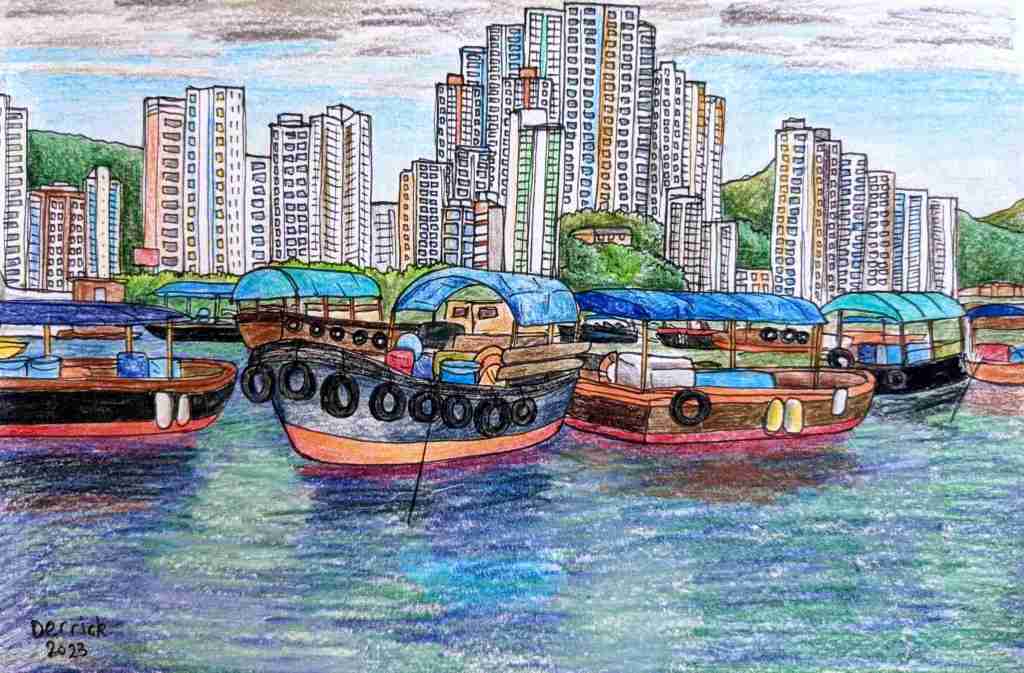
The fishing port of Aberdeen in Hong Kong is home to a floating community of over 600 junks. The present day floating village was established as a Typhoon shelter between Wong Chuk Hang and the island of Ap Lei Chau.
Most people living on the water in Aberdeen Floating Village are ethnic Hoklo and Tanka people, the latter of which are sometimes referred to as boat people. An estimated 6,000 people live on the fishing vessels of Aberdeen Floating Village – but at its height in the 1960s, it’s believed 150,000 people called the port home.
The floating village is an example of traditional culture contrasted with the busy city beyond. Families who live on the boats leave the harbour to fish, but tourism is becoming a growing industry too. Some floating restaurants and boat tours with Tanka guides are popular destinations for tourists.
Uros Islands, Lake Titicaca
The Uros Islands are man-made islets on Lake Titicaca, the highest navigable lake in the world on the border between Peru and Bolivia. The indigenous people who live on them are the Uros people, who originally built the islands as mobile homes in defence against invading Inca peoples. Altogether there are about 1,300 people, and all islands are made of layered totora reeds and roots. This native plant is water resistant, and used in medicine, as food, and and tea.
Each island is built with a strong base of tough totora roots, about 1-2 metres (3.3-6.6 feet) thick. On top of the roots go the totora reeds, which are sun dried and bundled together with rope, then laid down in alternating directions. The entire structure is anchored down with wooden eucalyptus stakes. There are around 60 to 100 islets, but the number is always changing. While very stable, the island structure is temporary, and the reeds need to be replaced once or twice a month to stop them rotting.
With fishing and bird hunting as a primary occupation, life on the Uros Islands requires boat transport, with either boats made of totora reeds, or motorised craft. After a devastating 1986 storm, many islands moved closer to shorelines for safety. There are more modern conveniences popping up on the islets, such as solar panels to power electric lights, TVs, and even a local floating radio station. Many Uros islanders are focusing on tourism too, selling AirBnb stays, selling souvenirs, or teaching visitors about their culture. Guided tours from Puno, Peru are the best way to visit the islands.

Waterbuurt, The Netherlands
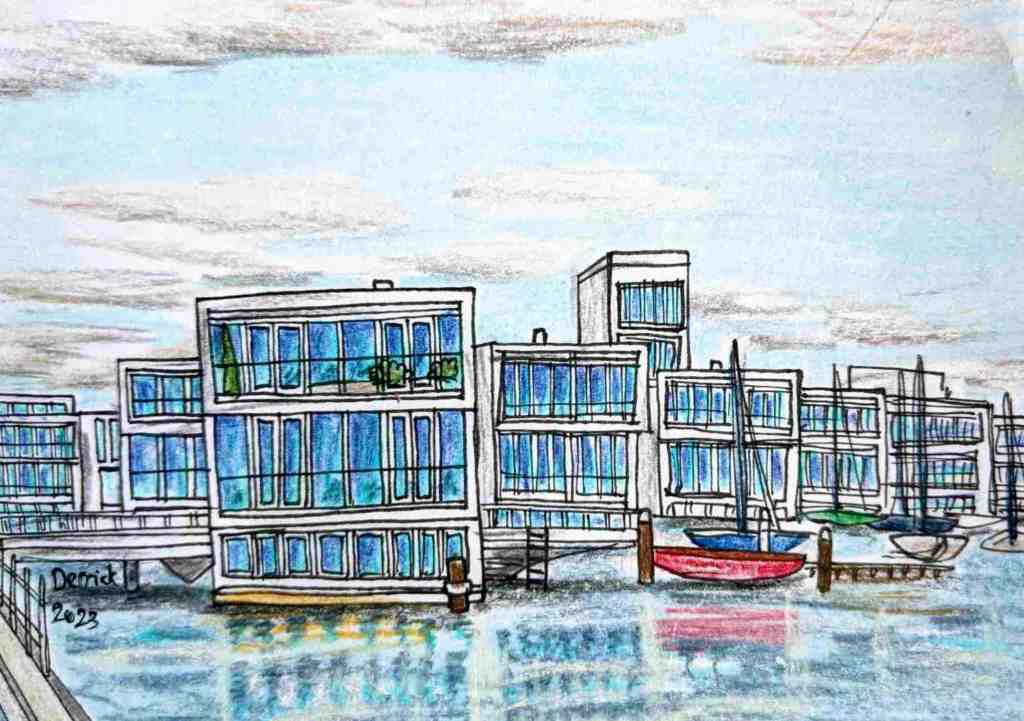
While houseboats have long been regarded as a quintessential Dutch icon, more modern ideas have made water living more structured. The neighbourhood of Waterbuurt (water quarter) in Ijburg, Amsterdam is made up of about 100 specially designed floating houses.
Making up a community entirely on the water, each house designed by architect Marlies Rohmer is connected to one of 4 fixed jetties. Underneath each house is a buoyant concrete tub, onto which the steel building is built. Water pipes, electric cables and waste pipes come out from underneath each house and run under the jetties. Steel pylon moorings ensure the houses stay in one place and don’t bump into each other.
Communities like Waterbuurt are an exciting new solution to address the issue of limited living space in the Netherlands, as well as the issue of rising sea levels that are a concern.
Makoko, Lagos, Nigeria
Lagos, the most populated city in Africa, is home a community sometimes referred to as the ‘Venice of Africa’. The city borders Lagos Lagoon, 6,000 square km (2,300 sq miles) of water beside the Atlantic. The community collectively known as Makoko began in the early 19th century as a fishing village, which expanded into an expansive slum as the city grew, with the majority of people moving onto stilted houses on the water.
Today, Makoko is made up of 6 distinct villages – 2 on land and 4 on the water. Each is headed by a local chief, or Baale. Because it is not recognised as a legal settlement and without proper records, the huge population can only be speculated at between 40,000 to 300,000. However, despite new plumbing systems being installed for drinking water, the standard of living is low, with little electricity, schooling or healthcare.
Many houses are made of wood, planted into the water bed with wooden stilts, whilst waterways inbetween serve as transport conduits for canoes. The most famous building in Makoko was probably the floating school, which rested on plastic barrels and was powered by solar panels. Sadly, it is no longer operational.

***
Living on the water for communities all around the world is an incredible adaptation to social and environmental circumstances. There are many other floating communities that exist around the world that weren’t mentioned on this list, such as the Lost Floating houses of Iraq, the stilted houses of Tonle Sap, Cambodia, or even the artificial Palm Islands, Dubai.
What other incredible floating communities could be on this list? Let me know in the comments below!
 StickyMangoRice
What a great overview of floating communities in different parts of the world.
Thanks! It was quite fun to research all these diverse communities
Excellent post, Derrick. I’ve only been to one on this list – Halong Bay. Fascinating and beautiful. Your artwork is charming – such talent. 🙂
Thanks very much! 🙂 I’ve been to Ha Long Bay too, very stunning