France has some of the most beautiful bridges in the world. While all bridges are functional as their main purpose, French designs over the centuries have given us some of the most impressive and amazing constructions in the world. From colossal engineering masterpieces, Roman ruins, Parisian classics, natural rock formations, and Medieval fortifications, let’s look at 15 French bridges that cross obstacles with style.
Viaduc de Millau
In terms of sheer scale, no bridge is more spectacular than the gigantic and elegant Viaduc de Millau. It’s the highest bridge in the world as of 2023, standing a mind-bending 336.4 metres (1,104 feet) – that’s higher than the Eiffel Tower! Completed in 2004, the 2,460 metre (8,070 feet) long cable bridge is also notable for its minimalist and beautiful style, sometimes compared to sailboats. The Viaduct de Millau crosses the green fields of the Tarn Valley, standing on seven slender pylons.
Viaduct de Millau is located in the Tarn Valley, in the Aveyron department of Occitanie. It is part of the A75 autoroute, that saves holiday traffic the trouble of driving through the valley below. Best of all is the Viaduct de Millau’s party trick; when fog fills the valley, the bridge is at its most whimsical, as it appears to float freely above the clouds.
Pont du Gard
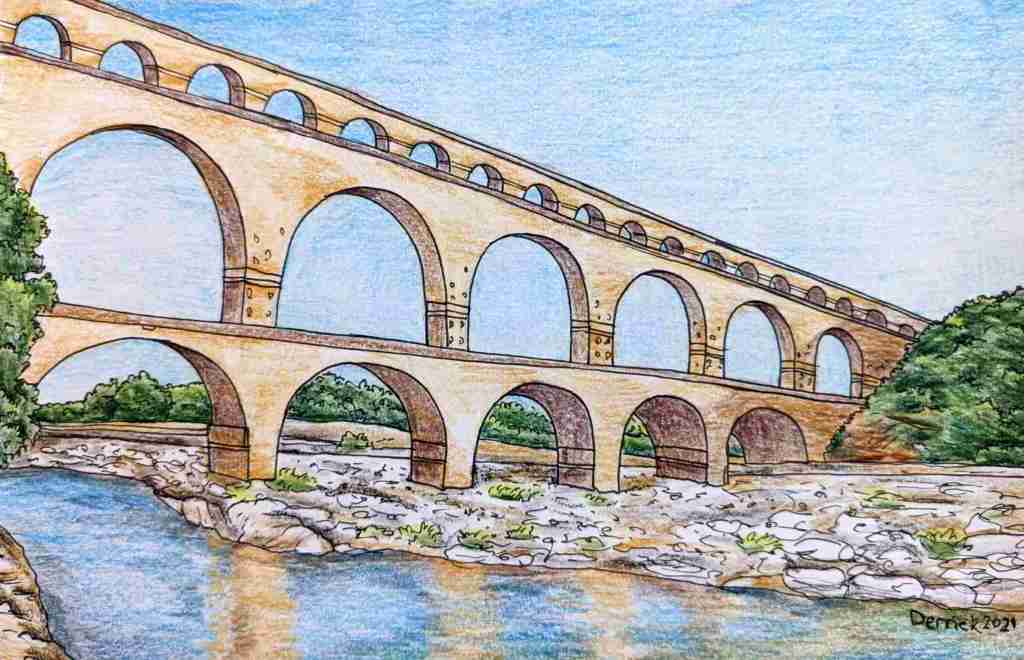
Located in the south of France, near the city of Nîmes in Occitanie is one of France’s most impressive Roman constructions – the Pont du Gard. Built in the first century CE, the Pont Du Gard functioned as an aqueduct. It helped transport water from natural water springs at Fontaine d’Eure to the Roman city of Nemausus (now Nîmes), 50km (31 miles) away. It stopped its water carrying duties towards the end of the Roman Empire, but it remained useful, serving as a toll bridge for foot traffic by medieval lords.
It’s historic value was increasingly recognised around the 18th century, and conservation efforts were undertaken to preserve the bridge. The emperor Napoleon III was particularly fond of the bridge, and approved renovation works. Today, the Pont Du Gard is a UNESCO World Heritage Site, and France’s most popular ancient tourist site. While people are not permitted to walk on the upper part of the bridge, a small parallel foot bridge was added in 1747, allowing pedestrians to walk alongside and admire the aqueduct’s colossal size.
Le Pont d’Avignon
One of France’s most famous medieval bridges is the Pont d’Avignon (also known as the Pont Saint-Bénézet) in the commune of Avignon. Located in the Provence region, the centuries-year old ruined bridge partly spans the Rhône river. It was built almost a millennium ago in wood between 1177 and 1185, before being rebuilt in stone in 1234.
Today, the bridge is in ruins and only 4 of the original 22 arches survive. It is classified as a UNESCO World heritage site, and is popular as a tourist attraction, with visitors permitted to walk along it. However, it might be more known for its own song – a 15th century children’s song called Sur le Pont d’Avignon, about a dance under the bridge!

Pont des Arts
The Pont des Arts in Paris is one of the most famous bridges in Paris, perhaps due to it’s unofficial alter-ego – the Love Lock Bridge. Located in the centre of the city, it links the Palais du Louvre with the Institut de France. It’s name comes from the Louvre, which was called Le Palais des Arts when the bridge was built. The original bridge was built between 1802 and 1804 under Napoleon Bonaparte, and was the first steel bridge in Paris. By 1976, the bridge was in a dangerous state, as boat crashes and bombing during the world wars culminated in 60 metres of bridge collapsing in 1979. A new bridge was rebuilt in its place and opened in 1984.
In 2008, the Pont des Arts began to attract its infamous ‘love locks’. Visitors would write or engrave a padlock with the names or initials of the two lovers, secure it to the railing, and then throw the key into the Seine below. By 2012, the bridge was heaving with locks, with locks attached to other locks and even bicycle locks added. In 2014, after safety concerns and the collapse of some railings, in addition to the keys polluting the Seine below, the locks were removed – over a million locks that weighed 45 tonnes! In their place, flat panels were installed featuring the works of local artists.
Château de Chenonceau
OK, the Château de Chenonceau in the Loire Valley is probably a castle first and a bridge second, but it’s worthwhile mentioning one of France’s most beautiful and visited castles. It is probably most known for its unusual structure, with a covered gallery and arches that span the river Cher. The current castle was built between 1514-1522, with the bridge portion added by architect Philibert de l’Orme in 1556-1559, and expanded into a gallery by Jean Bullant in 1570-1576.
Throughout its history, the château was a favourite of royalty and nobility, even hosting France’s first ever fireworks show in 1560. Today, the château is open for public visits. In addition to its spectacular position bridging the river, Chenonceau also has a beautiful gardens, and hosts public events.

Pont Neuf
The oldest bridge in Paris is one of the city’s most iconic. The Pont Neuf (new bridge) was completed in 1607, and was as much a work of art then as it is today. It was the first bridge to replace the lost Medieval bridges of Paris before the Haussmannisation of the city. The old bridges had houses and shops built on the bridge, leading to several collapses. The Pont Neuf was built in stone in two sections that meet at the Île de la Cité in the middle of the Seine.
The first stone of Pont Neuf was laid by King Henry III in 1578, and was a modern design for the time. It was the widest bridge in Paris when it was completed. To offer better views of the Louvre, there were no houses built on it, and it featured sidewalks and bastions to protect pedestrians from mud splashed by carriages. Some design features include mascarons, recreations of 381 stone masks of mythological divinities, satyrs, and sylvains. It also has a magnificent statue of King Henry IV on horseback.

Pont de Pierre
Crossing the Gironde river in Bordeaux is the city’s longest bridge, the Pont de Pierre (stone bridge), completed in 1822. It connects Avenue Thiers with cours Victor Hugo with a huge 487m (1598ft) span, and a width of 19m (62ft). The idea of bridging the Gironde was proposed by Napoleon, but carried out after the Bourbon restoration.
Today, the bridge is only open to pedestrians, as well as public transport such as trams, bicycles, buses, taxis and emergency services.
Pont Alexandre III
Pont Alexandre III is one of the most extravagant and beautiful bridges in Paris, crossing the Seine near the Grand Palais. Named after the Russian Czar Alexandre III, it was completed in 1900 and was unveiled at the Exposition Universelle. At 160 metres (520ft) long, 40 metres (140ft wide) and 6 metres (20 ft) high, all on a single steel arch, it is a masterpiece of engineering.
The Pont Alexandre III is perhaps best known for its ostentatious design that echoes the style of the Grand Palais, with gilded statues, ornate street lamps and four 17 metre high pylons on each extremity, topped with bronze statues of winged horses. It also has amazing views of the Eiffel Tower (especially at night) making it one of Paris’s most iconic bridges.
Pont Ambroix
Pont Ambroix (or Pont d’Ambrussum) is a ruined Roman bridge over the Vidourle river that dates back to the 1st century BCE. Located near the towns of Gallargues-le-Montueux and Villetelle. From what used to be 11 stone arches in Roman times is now just a single lonesome surviving arch. Curiously, its history of collapse is documented in art; a 1620 sketch by Anne Rulman shows 4 arches. When Gustave Courbet painted it in 1857, only 2 remained.
It was part of the Via Domitia, an important westward paved road used by the Roman Empire. While it was still in use in Medieval times, major floods along the Vidourle river over the centuries destroyed it arch by arch.
Pont Valentré
A UNESCO World Heritage Site, the 14th century Pont Valentré is a stone arch bridge crossing the river Lot in Occitanie. Known for its 3 monumental fortified towers and Gothic-style arches, le Pont Valentré is a symbol of the city of Cahors.
Pont Valentré is also known as the Devil’s Bridge. The construction started in 1308, and progress was so slow that it was said that the architect offered Satan his soul if he used his skills to speed up the building. The architect, attempting to keep his soul, tricks Satan by ordering him fetch water for the last batch of mortar with a sieve, ensuring it was never finished. As punishment, Satan sent a demon every night to remove a stone from the central tower ever night, ensuring that the bridge is never complete. A statue of a demon was incorporated into the brickwork in 1879.

Viaduc de Garabit
The Viaduc de Garabit, a wrought iron rail bridge over the Truyère river, was designed by one of France’s most famous architects, Gustave Eiffel. With a style similar to the Eiffel Tower, the Viaduc de Garabit is 565 metres (1,854 ft) long, 6 metres (20 ft) wide, and at 124 metres (407 ft) high was the highest arch bridge in the world when it opened in 1885.
The Garabit Viaduct is still in use today, however in 2009 cracks were discovered in one of the foundations. Now, passenger trains can only pass across it at 10km/h (6 miles/h).
Briare Aqueduct
One of France’s most suprisingly beautiful bridges is the Briare Aqueduct, a navigable aqueduct that carries water from the Canal latéral à la Loire over the river Loire. The canal near Châtillon-sur-Loire in Centre-Val de Loire was opened in 1896, with 14 piers supporting the 2.2 metre deep waterway. Boats cross regularly, and pedestrians can cross too, with ornate street lamps lighting the way across.
Pont d’Arc
One of France’s most amazing bridges is the naturally formed Pont d’Arc formed by the Ardèche river eroding through a limestone formation. Approximately 400,000 years old, the Pont d’Arc is around 50m high and 60m wide. It is a popular site for tourists, especially canoes and kayaks, who travel under the bridge down the Ardèche river.
The Pont d’Arc is part of the greater Gorge de l’Ardèche area, sometimes nicknamed the European Grand Canyon. It is located in the Ardèche department of the Auvergne-Rhône-Alpes region in Southern France. Another nearby attraction is the Grotte Chauvet-Pont d’Arc, a cave that features some of the oldest and most impressive cave paintings ever discovered.
Pont Julien
Pont Julien is one of France’s oldest bridges, a Roman arch bridge over the Calavon river dating back to the 3rd century CE. Named after Julius Ceaser, the bridge is located near the village of Bonnieux in the Provence region. It was part of the Roman road Via Domitia, which ran from from modern day Spain through to Italy. As one of France’s most impressive Roman sites, Pont Julien has been in use for over 2000 years, and while pedestrians and bicyclists can still cross, car traffic was diverted in 2005.
There is a curious plaque on the bridge, immortalising the last car to pass over it, an Irishman named Finnbar MacEoin. It reads: “We do not know who was the first person to cross but an Irishman was the last.”

Pont de Bir Hakeim
Famous for its sensational views of the Eiffel Tower, the Pont de Bir Hakeim is a two storey bridge over the river Seine. The upper level is for Metro line 6 trains that run over the river between Passy and Bir Hakeim metro stations (one of the rare times the metro comes above ground). Below is a road and pedestrian sidewalks. It crosses over the Île aux Cygnes, and the island’s Statue of Liberty replica can be seen from the bridge.
Pont de Bir Hakeim was completed in 1905, replacing an older bridge that stood in its place. It was originally called Pont de Passy, but was renamed post-war to honour the great French victory at Bir Hakeim in North Africa. With its iconic views, and beautiful wrought iron style, crossing Pont de Bir Hakeim is a must-do for visitors.
***
That completes my list of 15 amazing bridges in France! But there are hundreds more worth mentioning. Which bridges have I left off the list? Let me know in the comments below!
 StickyMangoRice