While today Paris is known for its beautiful and elegant bridges, the city has also lost many bridges through centuries of disasters. Viking attacks, deadly fires, overweight from too many houses built atop, washed away in floods, boat strikes, and even stray ice blocks all contributed to the demise of Paris’ lost bridges.
In 1607 the Pont Neuf bridge was completed in Paris. At the time, it was the most sophisticated example of bridge engineering in the city. It was the first bridge in Paris without houses built on it, and the first to have sidewalks, setting the standard for all subsequent bridges. Today, however, Pont Neuf (new bridge) is the oldest remaining bridge in Paris, with dozens of other bridges that were all built in the centuries since 1607. In Medieval Paris, crossing a bridge over the Seine could be a deadly journey.
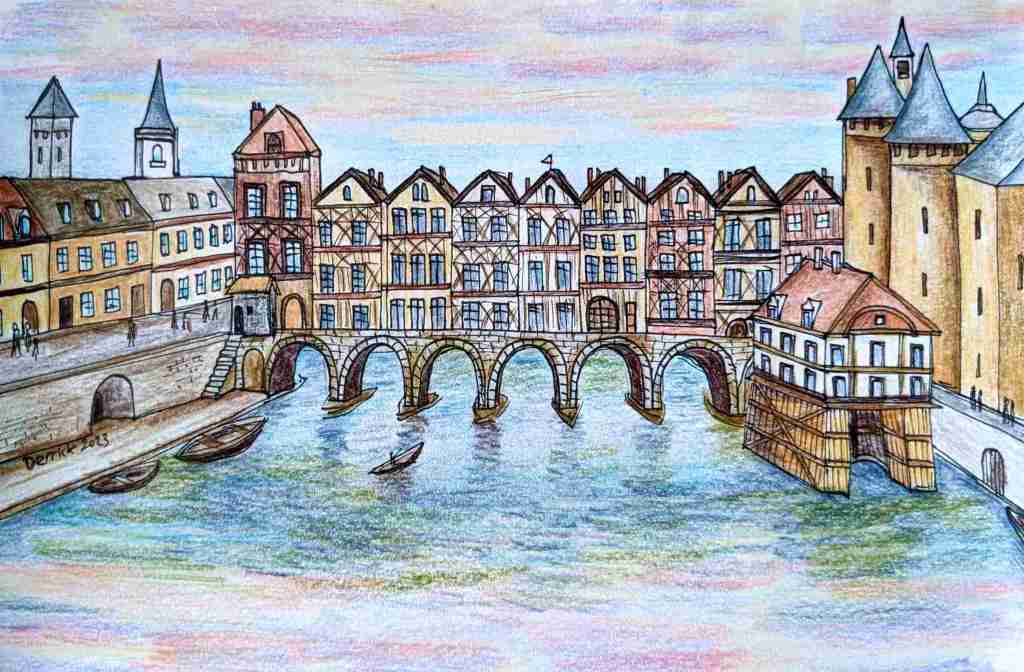
So what happened to the old Parisian Medieval bridges, these unlucky or dangerously built constructions? What did they look like? And how did people build multi-storey houses on a bridge?

When considering streets and buildings in Paris, the 17th century and earlier was a very different city to the one which exists today. The Medieval buildings were hugely overcrowded, with narrow serpentine streets, poor sanitation, and rampant disease problems. Cholera was rampant, and crime was so bad in some parts of the city (such as Petite Pologne) that police didn’t dare go there at night. The visionary town planner and prefect Georges-Eugène Haussmann undertook a large scale renovation of the city between 1854 and 1870. Entire buildings and city blocks were torn down, and replaced with the iconic sandstone buildings, street lamps, parks, and grand boulevards that make Paris beautiful and unique today. While he was eventually removed from his position, Paris was a cleaner, more organised, safer city.
The First Bridges of Paris – Petit Pont and Grand Pont
For most of the early history of Paris, boats were the only way to navigate to and from the Île de la Cité, an island in the Seine and the first settlement of Paris. A merchant ship (marchands de l’eau) is on the city’s coat of arms today. The Gauls are said to have built wooden foot bridges over the Seine, but were destroyed to keep Roman armies at bay.
The first recorded bridges in Paris were named the Grand Pont and the Petit Pont, connecting the city centre of the Île de la Cité. The Petit Pont linked the Île de la Cité to the left bank, and the Grand Pont to the right bank. In the 9th century, Viking incursions saw the Grand Pont destroyed. By the 12th century, the Grand Pont had been destroyed and rebuilt a number of times. The bridge was narrow and congested, and traffic accidents were common.
From the Grand Pont to the Pont au Change
However, Paris was greatly expanding in wealth. The Île de la Cité was growing site of commerce, with a decree in 1141CE from King Louis VII stating that money changers, jewelers and goldsmiths must operate from the newly built Pont au Change bridge. These French and Italian traders built their houses and shops right on top of the bridge – tall wooden multi-storey buildings that occupied every space either side of the road. One could cross the bridge and not even see the river beyond.
Bridges like the early Pont au Change, heavily overloaded with structures, were at high risk of disaster. Floods and freezing winters were extremely damaging over the centuries. A particularly catastrophic flood in December 1296 washed away all the bridges in the entire city, whilst a harsh winter in 1408 froze the Seine, and when it thawed the ice blocks again destroyed all the bridges in Paris. Another flood ruined the Pont au Change in 1616. The end of the Medieval-era Pont au Change was a fire in October 1621, that brought the whole bridge unceremoniously crashing down.
The traders that lived and worked on it asked King Louis XIII if they could rebuild it at their expense. It was approved and was built in stone between 1639 and 1647 in a new location. The new seven-arch Pont au Change was 32 metres wide, the widest bridge in Paris when it was complete. The houses, however, were deemed dangerous and were removed in 1788. It was demolished during Haussman’s renovation of Paris in 1858, who needed to relocate it to line up with new boulevards. Completed in 1860, the elegant 3-arch Pont au Change is the bridge we still see today.
Le Petit Pont
The other original bridge of Paris, le Petit Pont, shared a similar fate of constant destruction and rebuilds. The wooden bridges from antiquity are not well recorded, but the Medieval-era Petit Pont iterations were annihilated no less than 13 times by floods from 885 to 1658. One notable bridge was the 1175 Petit Pont, overseen by the Maurice de Sully, Bishop of Paris, who also planned construction of the Notre Dame de Paris.
Catastrophe struck the Petit Pont in 1718, when two barges loaded with hay were ignited by a passenger in another boat carrying a taper in the middle of the night. The conflagration drifted into the Petit Pont, burning down the bridge and all the houses built on it (and likely some unlucky Parisian bridge-dwellers too). It was replaced with a 3-arch bridge the next year, with house building prohibited. In 1853, the present-day incarnation of the Petit Pont was finished with a single arch to reduce congestion.
Les Planches de Milbray becomes the Pont Notre-Dame
The bridge that stands on the original site of the Grand Pont is the Pont Notre Dame. Its original form was called Les Planches de Milbray (Milbray plank bridge), a wooden bridge that replaced the Roman stone bridge destroyed by Viking marauders in 886, although its existence is contested. A fire in 1111 brought down the Planches de Milbray, which were replaced by stone bridges that stood until the great floods of 1296, then another collapse in 1406. In 1412, under the order of King Charles VI, the first bridge was built which was named Pont Notre-Dame.
The 1412 Pont Notre-Dame was celebrated for its beauty, with 60 uniformly-sized houses reaching an impressive height. Unfortunately, it collapsed in 1499 due to structural problems. In 1507, the new Pont Notre-Dame was completed, with a new row of houses (and Paris’s first official house numbers!). By 1746, the houses were becoming too unsanitary and unstable, and by 1788 they had been removed. A new stone bridge was built in 1853, but because it caused a high number of boating accidents, a new steel bridge was built in 1919, which still stands today.
Paris Grows To 37 Bridges
By the 18th century, Paris was Europe’s second largest city, with over 600,000 people, and ballooned soon afterwards as the city annexed surrounding communities. The roads and bridges of the city had to keep up with growth, so many more bridges were built over the centuries.
Some of the most famous and beautiful bridges in Paris were built not long after Pont Neuf in pre-revolutionary France, such as Pont Marie (1635), Pont Royal (1689), and Pont de la Concorde (1791).
Others were created or renovated as part of Haussmann’s public works and continuation of his plans. These include the Pont de l’Alma (1856), Pont des Invalides (1855), and Pont Saint-Michel (1857). The 20th century also saw a large number of bridging projects, starting with the elegant and ostentatious Pont Alexandre III (1900).
Some historic bridges are recently rebuilt, like the love lock bridge, Pont des Arts (1984), and the Pont de Grenelle-Cadets-de-Saumur (1966). The newest bridge over the Seine in Paris is the Passarelle Simone de Beauvoir, a striking wave-shaped pedestrian bridge which opened in 2006.
Paris Bridges Today
The old Medieval bridges of Paris were in many ways like the city; overcrowded, unsafe, and not built to last. Today, each of the 37 bridges in Paris has its own story to tell, and together they are protected as a UNESCO World Heritage Site. It took centuries of war, natural disasters and accidents to shape the bridges of Paris into what they are today.
With new engineering techniques and the requirements of a modern, 21st century society, the bridges of Paris truly are a time capsule in French history. And it’s worth sparing a thought for what bridges used to stand in their place, who lived on them, and how the city has changed the next time you walk across one.
 StickyMangoRice
Wow, what a nice history of les ponts de Paris. I did not know much about the houses on the bridges so it was interesting.
Thank you! Yes it’s interesting – and a shame none of them survived, although I think some bridges with houses still exist in other parts of Europe.
We have seen bridges with buildings in Bath England, and in Florence Italy.