Known for its challenging forest hikes, sparkling coastline and diverse wildlife, Bako National Park is one of the most amazing places to see unique animals in Borneo. Located in Sarawak, the Malaysian part of Borneo, Bako National Park has been a protected area since 1957, making it Sarawak’s oldest National Park.
It’s also the smallest national park in Borneo, at just 27 square kilometers (16.7 square miles). However, packed inside are a variety of ecosystems and biomes, with grasslands, mangroves, beaches, swamps, and forests. A visitor’s centre and accommodation is available for visitors hoping to stay overnight to see native species. From proboscis monkeys to bearded pigs to vipers (and even some nocturnal primates), here are some of Bako’s most amazing animals.
Mammals
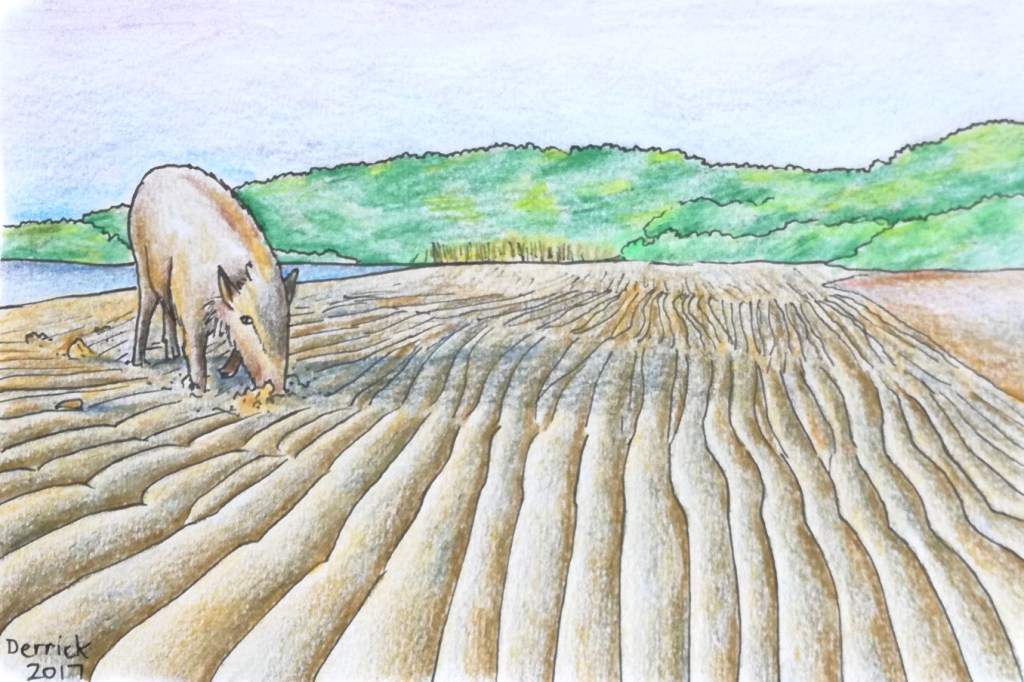
Bornean Bearded Pigs (Sus barbatus)
Native to parts of South East Asia such as Borneo, Sumatra, and the Malay Peninsula, bearded pigs are wild pigs notable for their long heads and prominent beards. Often found shuffling around around the visitor’s centre in Bako National Park, these are the largest mammals at Bako. Bearded pigs are omnivores that dig for crabs in mangrove areas, and are also masters of locating fungi, roots, small vertebrates, fruits, and more in the thick forests. They can reach around 160cm (5 ft 3), and weigh 40-150kg.
Plantain Squirrel (Callosciurus notatus)
With a territory ranging from Malaysia, Thailand, Singapore and Indonesia, the plantain squirrel is adapted to life in the forests and mangroves of Bako National Park. They can reach sizes around 40–60cm (16–24″) including their tails, and have a distinctive black and white stripe along their sides. Plantain squirrels live mostly in the trees, where they feed on leaves, fruits, insects and occasionally eggs, rarely venturing onto the ground.
Oriental Small-Clawed Otter and Hairy-Nosed Otter
Two otter species live in Bako National Park, the Oriental small-clawed otter and hairy-nosed otter. The small-clawed otter, named for its claws that don’t extend past its foot webbing, are widespread throughout South East Asia. The hairy-nosed otter is much rarer, living in Borneo, parts of Thailand, Cambodia, Vietnam, Sumatra and Malaysia. It is extinct in many other countries. Both live in the marine habitats of the national park, where they feed on frogs, fish, crabs, and other small animals. They can be spotted in Sungai Assam stream, and Telok Assam mangroves.
Other Mammals of Bako National Park
There are many other important and unique mammals that live in Bako National Park. For visitors hoping to spot wildlife at night time, nocturnal species include the Sunda pangolin (Manis javanica), ant ant-eating mammal covered in wide scales that resemble those of a pine cone. The palm civet (Paradoxurus hermaphroditus) also ventures out at night, as does the tiny mouse deer (Tragulus kanchil).
Primates
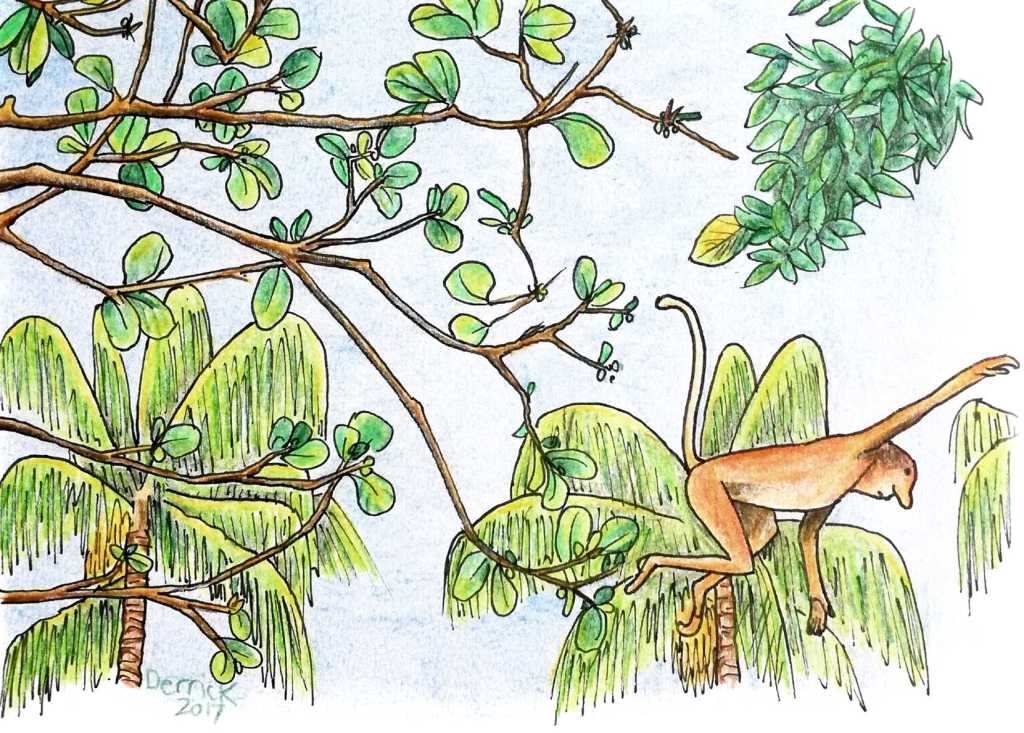
Proboscis Monkey (Nasalis larvatus)
The star of Bako National Park is the proboscis monkey, or long-nosed monkey. Instantly recognisable for its bright red-brown fur, slender tail, pot belly, and oversized bulbous nose, the proboscis monkey is endemic to the island of Borneo. One of the largest Asian monkeys, the species prefers coastal forest habitats such as mangroves, swamps, and rivers. The nose, thought to be involved in vocalising, is much larger in males and can exceed 10cm (4″) long!
The species is endangered and numbers in the wild are low, but for visitors to Bako National Park, proboscis monkeys are comfortable with humans and are sometimes spotted around the visitors centre. Setting these rare creatures is often the highlight of a visit to Bako.
Crab-Eating Macaque (Macaca fascicularis)
The crab-eating macaque or long-tailed macaque is widespread across South East Asia. Considered a pest in cities and farms, and also used for medical experiments, the crab-eating macaque thrives in the forests of Bako National Park. A medium-sized monkey, the macaque has a slim tail longer than its body, light grey colouring with brown on the upper body, and characteristic face whiskers.
Despite the name, the crab-eating macaque doesn’t usually eat crabs! It prefers fruit, leaves and bark, as well as small vertebrates, fish, frogs, and lizards. However, because they’re so comfortable living near human settlements, macaques frequently raid garbage bins, steal bags, and enter the kitchens at Bako HQ.
Silvery Lutung (Trachypithecus cristatus)
The silvery lutung (also called silvery langur or silvered leaf monkey) lives in Borneo, Sumatra and peninsular Malaysia. As the name suggests, it has a coat of grey-tipped fur that appears silver, a long grasping tail, and a tuft of spiky hair on its head. Curiously, the babies are born bright orange! The silvery lutung is herbivorous, eating mostly leaves with the help of a specialised stomach to digest cellulose.
Bornean Slow Loris (Nycticebus borneanus)
The Bornean slow loris is a nocturnal and arboreal primate. It has large, forward-facing eyes on a flat face, grasping hands, a vestigial tail, and short ears. The slow loris feeds mostly on insects, fruit, nectar, and tree gum.
Horsfield’s Tarsier (Cephalopachus bancanus)
One of the smallest primates in the world is the famously shy Horsfield’s Tarsier. A nocturnal primate that occurs mostly in Borneo and Sumatra, tarsiers have extremely large eyes, padded fingers, and very long tails. They sleep in folds in trees during the day and by night come out to eat insects, and have been known to eat bats and snakes.
Reptiles
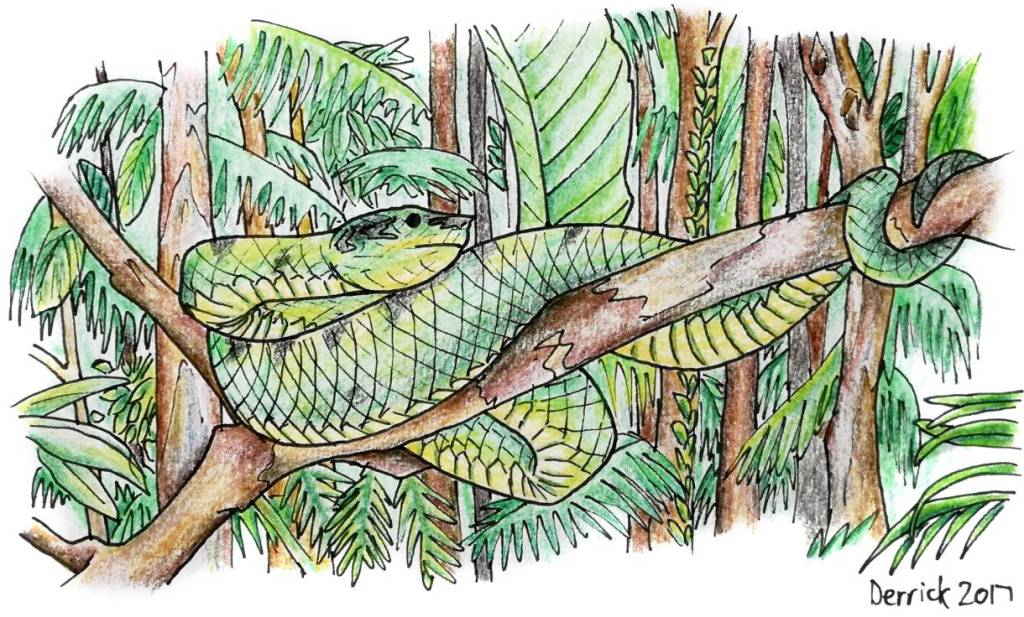
Bornean Keeled Pit Viper (Tropidolaemus subannulatus)
The Bornean keeled pit viper is a venomous snake that lives in Borneo, as well as Indonesia, Brunei, and the Phillipines. It is arboreal and an excellent climber, often remaining completely still to ambush prey such as small mammals, frogs, lizards, and birds. They are identified by their green colour with yellow underbelly, and bicolour bars along its body. Females can measure up a metre long (39″), and males around 75cm (29″).
Asian Water Monitor (Varanus salvator)
The wide ranging Asian water monitor lives across India, South East Asia and China. They are the second largest lizard in the world after the Komodo dragon, typically growing up to 1.5-2 metres (4’11” – 6’7″ feet) long. Monitors are carnivorous, and eat fish, mammals, snakes, birds, and scavenge carrion. They are well suited to the coastal habitat of Bako National Park; monitors are strong swimmers and can climb trees when necessary.
Green Crested Lizard (Bronchocela cristatella)
Found throughout South East Asia, and as far as India, the green crested lizard is one of Bako National Park’s cutest residents. This small, bright green lizard is able to change its colour to brown when threatened.
Aquatic Animals and Invertebrates
Aquatic Wildlife of Bako National Park
Bako National Park has lots of coastal areas, rivers, wetlands, and mangroves, which are ideal habitats for a variety of aquatic wildlife. On the muddy flats by the sea, fiddler crabs with oversized claws come in a variety of colours, especially striking electric blue species. Mudskippers share their habitat as well. In the deeper waters, fish, starfish, anenomes, and annelid worms populate the sea.
Invertebrates of Bako National Park
Some truly huge insects abound in the warm conditions of the Bako National Park. The giant stick insect Phobaeticus chani lives in Borneo, as does the praying mantis Paratoxodera borneana. Colonies of large ants such as Dinomyrmex are also a common sight on the forest floor, as are termites.
***
Bako National Park in Sarawak has a huge biodiversity, and describing all the beautiful animals that live there is an impossible task. However, the animals listed above represent some of the most well-known species that visitors can observe in the wild.
 StickyMangoRice