My biggest travel regret was in Thailand in 2012, when I took a tour of the forests around Chiang Mai on elephant back. It was part of a year-long round the world trip, making up my journey as I went along, in the days when I had no phone, and lived out of a well-worn counterfeit Lonely Planet. As a naive young backpacker I didn’t realise it at the time, but I was probably part of an industry of cruelty and pain for the very animals I came to admire.
I was staying in Chiang Mai for about a week, and one of the most recommended activities was to take an elephant tour. So, I booked one with the hotel, and went along.

Chiang Mai Elephant Tours
Elephant riding seemed like a fun and interesting activity. And as far as I knew, completely acceptable in the tourism world – it was in my travel guide, after all. Besides, elephants have provided a form of transport for millennia, haven’t they? Just like horses?
Well, not exactly the same thing.
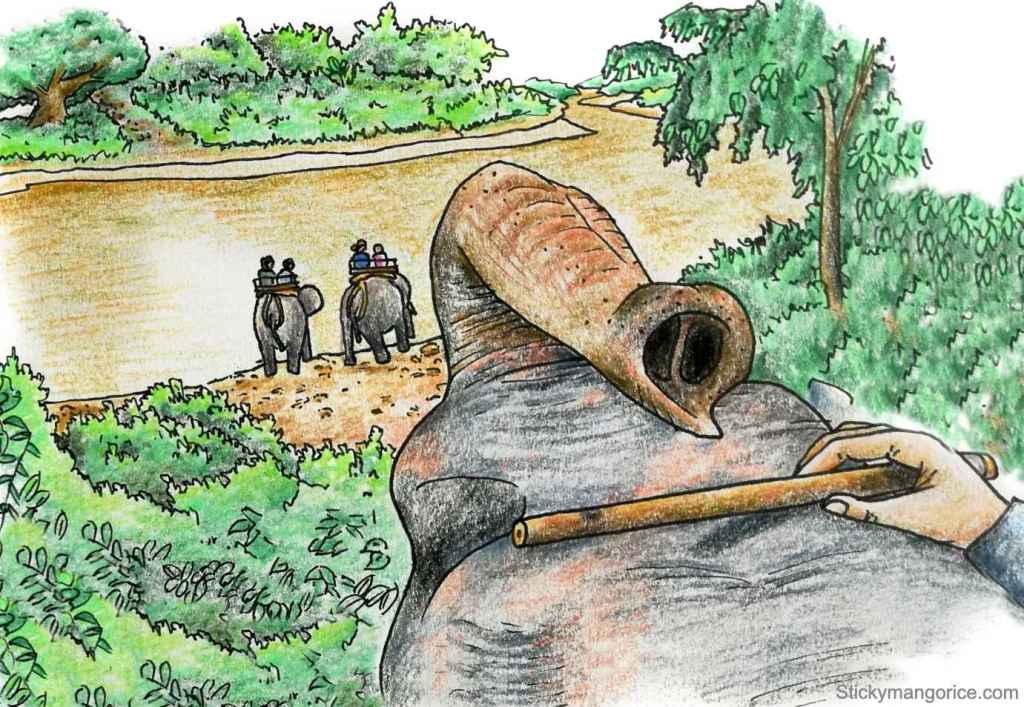
The tourist group I was with mounted the elephants with a special platform. Each elephant had three people on top, a rider sitting on the neck, and two tourists on the howdah (the wooden chair attached to their back). A procession of 4 or 5 elephants wandered around a well-trodden dirt track through the forest, through some shallow water, then back to the camp. Altogether it was around 15 or 20 minutes.
When we were underway, I saw something strange in the hands of the rider. The savage curved spiked of a bullhook. I know what it is now, but at the time I didn’t. What was it for – striking the elephant!? It looked cruel, and suddenly I felt uneasy about the whole experience, leaving Chiang Mai with mixed feelings.
Elephant Tourism Stats
The World Animal Protection charity reported statistics on elephants in tourism in 2016. They identified 2,923 elephants in 220 tourist-related centres in Thailand, Sri Lanka, Nepal, India, Laos and Cambodia. Of these, 77% of elephants (2,250 elephants) were badly mistreated. Thailand is the biggest player in the elephant tourism market, accounting for more than half of the total elephants, more than all the other listed countries combined.
As Thai tourism grew between 2010 and 2016, the number of captive elephants went from 1,688 to 2,198. World Animal Protection also details public sentiment to find out if people believed elephant tourism was ethical. When surveyed in 2014, 53% of the sample group (1000 people) found riding a elephant acceptable, and 40% unacceptable. 3 years later in 2017, 44% found it acceptable and 49% found it unacceptable.
Obviously, information of mistreatment of elephants is not shared with tourists. So what exactly happens behind the scenes in an elephant sanctuary?
Exposing Cruelty Towards Elephants
WorldNomads describes the investigation of a 2014 investigation by World Animal Protection. They found that elephants used for tourist rides experience great mistreatment during their captive lives.
Elephants which are selected for tourist rides undergo a ‘breaking’ when they are young, a process known as phajaan. During their breaking, they are taught to fear abuse with bullhooks, a curved spiked attached to a stick. The purpose is to make the elephants more obedient.
Once elephants are put into service ferrying tourists, they can develop permanent damage to their spines as they support the weight of people and the howdah. The elephants also experience blisters and foot problems from carrying these loads all day. Meanwhile, baby elephants are forced to endure the same arduous treks as adults, chained to their mothers.
At the end of the day, elephants are kept in cramped, squalid conditions. Often they are chained, given a concrete floor to sleep on, with stressful noise such as music or road noise nearby. The elephants are also kept alone and deprived of their usual social interaction needs. They can be underwatered or underfed, and show signs of severe psychological distress such as pacing and bobbing their heads.
How Can I Interact With Elephants Ethically?
Since the appalling circumstances of elephant raising has become increasingly under the spotlight, tourists have a greater responsibility than ever to make informed choices. Whenever elephants are being used for rides, use a brush to paint a pretty painting, or perform in a circus, it is safe to assume that the animals have undergone significant abuse to get them to that stage.
Some businesses advertise ethical treatment of elephants, but these claims must be taken with a grain of salt. Calling it an elephant sanctuary, retirement home, or rescue centre are just meaningless titles, and do not guarantee the elephants are being treated humanely.
Non-Riding Elephant Sanctuaries
In 2020, MandaLao in Laos opened as the first non-riding elephant sanctuary in the country. Similarly, ChiangChill in Thailand switched its focus from a sanctuary offering rides to one where elephants can be observed in social settings. Other Thai elephant sanctuaries changing to a more ethical model are Elephant Nature Park and Boon Lott’s Elephant Sanctuary. Yok Don National Park in Vietnam and Chitwan National Park in Nepal are also banning elephant riding.
Since the exposure of the truths of elephant treatment in 2014, many travel companies have taken a stand on promoting unethical elephant treatment. Over 200 travel companies (and counting) will only sell trips to ethical elephant businesses. In 2016, TripAdvisor has also begun vetting elephant sanctuaries, removing all links to elephant riding. In 2019, Angkor Wat ceased their elephant rides.
While groups such as PETA have actively campaigned to successfully remove elephants from circuses in the USA, there are still many places across South East Asia where elephant riding is still allowed. In fact, some sanctuaries market non-riding tours during the morning, but then change their name midway through the day to offer rides to other clients. However, some groups such as the Asian Captive Elephant Working Group (ACEWG) have begun a process of elephant welfare certification.
To check if the elephant park you want to visit is treating elephants humanely, use this checklist at World Animal Protection.
The Best Elephant Interaction is No Interaction
Ideally, the best place to see elephants is in the wild, with little to no interaction with humans. Addo Elephant Park in South Africa and Minneriya National Park in Sri Lanka are wonderful examples.

***
Interaction with elephants in South East Asia is certainly one of the most exciting activities that visitors like to do. But the days of assuming that the elephants are happy entertaining tourists are long gone. The truth of elephant abuse is out there, and visitors have a responsibility to ensure that the elephant experience they want is ethical and cruelty-free.
What are your thoughts on elephants being exploited for tourism? Have you done an ethical elephant experience in Asia? Let me know in the comments!
 StickyMangoRice