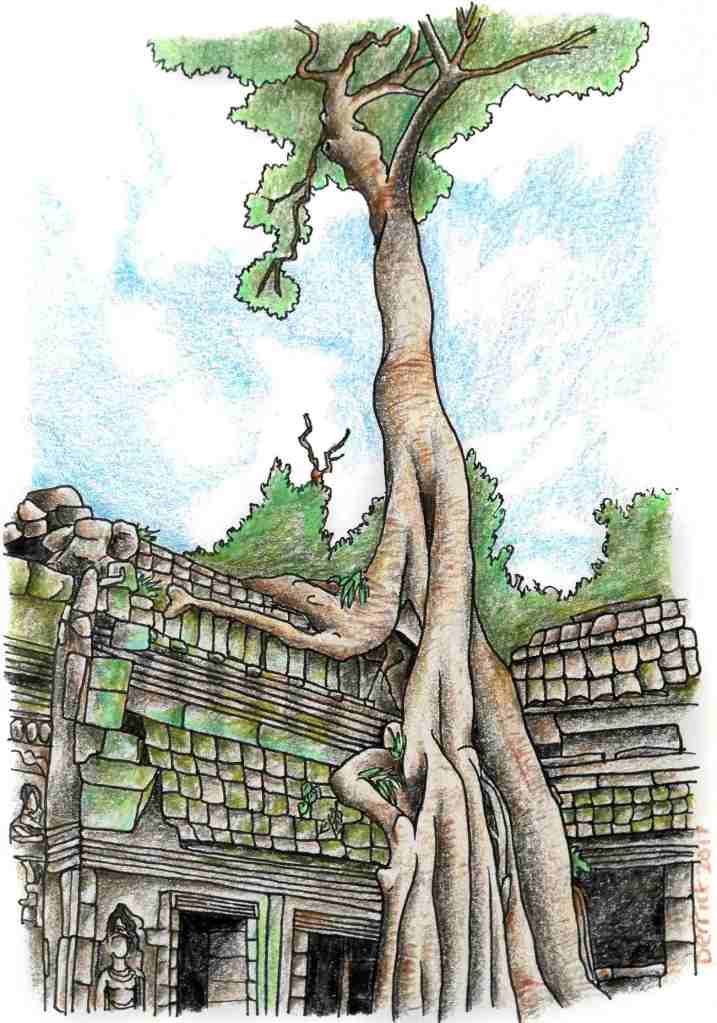
Ta Prohm is one of the most enigmatic and haunting of all the temples of Angkor in Cambodia. Sometimes known as the ‘Tomb Raider Temple’, Ta Prohm Temple was abandoned centuries ago by the Khmer empire to be reclaimed by the jungle. Most striking are the massive strangler figs and other trees growing on top of the ruins, with powerful roots anchored into the cracks between the stones, intertwining the temple with the natural world. The tree canopy above filters light through, speckling the mossy ruins with sun. Built over 800 years ago to accommodate tens of thousands of people, and now eerily abandoned, Ta Prohm is one of the most unique sights in the country.
History of Ta Prohm
The temple complex of Ta Prohm was built during the reign of the Khmer king Jayavarman VII, who ruled from 1181-1218CE during the heyday of the Khmer empire. His reign was one of grand construction projects, and his achievements are unrivalled in Khmer history – Ta Prohm, Preah Khan, Bayon, and the city of Angkor Thom are all credited to the King.
Ta Prohm (which means ‘Ancestor Brahma’, originally named Rajavihara, or ‘Royal Monastary’) was completed in 1186. The history and population numbers are well documented on stone reliefs. It was built in honour of the king’s family, and dedicated to his mother. It functioned as a monastary and university, and was a vibrant and bustling complex of courtyards, corridors, and now-lost villages. Inscribed in stone, its population is mind-boggling for the age, with 12,500 inhabitants, 600 dancers, and 20 high priests. 80,000 villagers lived in over 3000 surrounding villages to support the running of Ta Prohm.
The temple complex continued to expand for the following centuries, before it was suddenly abandoned in the 16th century during the fractured decline of the Khmer empire. The natural world rapidly moved in to Ta Prohm, with silk-cotton trees, thitpok, gold apple and strangler fig trees establishing themselves in cracks in the stonework. Over the centuries, the stones were levered apart, mighty roots spilled down the walls like a liquid, and moss and lichens covered the once mighty walls.
Restoration of Ta Prohm
While the temple of Ta Prohm was never truly lost in the jungle (subsequent powers and explorers have known of is existence), archaeologists developed a keen interest in the ruins in the early 20th century.
It wasn’t until the 21st century that conservation efforts began in earnest. It was decided by the École française d’Extrême-Orient, a French archaeological society that studies Asian culture, to leave Ta Prohm in its overgrown state. Instead of trying to repair Ta Prohm, efforts were made to stabilise the ruins to accommodate visitors, and allow safe access.
In 2013, renovations were carried out by the Archaeological Survey of India, including improving walkways, platforms and roped off boundaries. In 1992, the temple was confirmed as a UNESCO World Heritage Site.
Inside Ta Prohm
The layout of Ta Prohm is arranged with a rectangular outer wall measuring 600m (1968ft) by 1000m (3280ft), each with an entrance gate building called a gopura. Each gopura is adorned with a stone face relief similar to the temple of Bayon. Inside the walls would have been a large town, although today only jungle remains. The temple is a flat style (rather than a pyramid structure).
In the central walled courtyard are towers, walkways, and galleries to explore, however the trees and collapsed masonry make some areas impassable. Some of the most famous trees have nicknames; the ‘crocodile tree’ is on the inside of the eastern pavilion entrance of the central courtyard. The ‘tomb raider tree’ in the central sanctuary is where Angelina Jolie picks a flower in the film, before falling into the cavern below.
The Ta Prohm Stegosaurus
One of the more curious discoveries in the stone artworks is what looks to be a carving of a stegosaurus. While many accept that it is likely a carving of a different animal bordered by smaller shapes, others wonder if the peoples of the Khmer empire had knowledge of dinosaurs.
Filming Tomb Raider at Ta Prohm
Ta Prohm was used as a filming location for the 2001 movie Tomb Raider, starring Angelina Jolie as Lara Croft, an adventurer. When it was shot in 2000, it was the first time a film was filmed in Cambodia since 1964’s Lord Jim. The scene at Ta Prohm shows Lara exploring the grounds of the temple to find a way into (fictional) underground levels. Trying to reach the underground level before Lara’s rivals, a young girl points the way to where the entrance is.
The scene was very influential for Cambodian tourism. The beams of light shining through the jungle mist onto the stones and trees of Ta Prohm depicted a wild and mysterious place in the world. Many people became aware of Cambodia’s fascinating archaeological history, and visitors increased greatly to the site.
***
Ta Prohm is often considered one of the ‘big three’ temples of Angkor, together with Angkor Wat and Angkor Thom. These are the the temples of the grandest scale most understood by archaeologists and visited by tourists. Ta Prohm is perhaps the most mysterious and alluring of them all – the mighty strangler figs destroying and supporting the ancient Khmer ruins beneath are one the most incredible sights in all of Cambodia.
 StickyMangoRice